The Gate Back Home
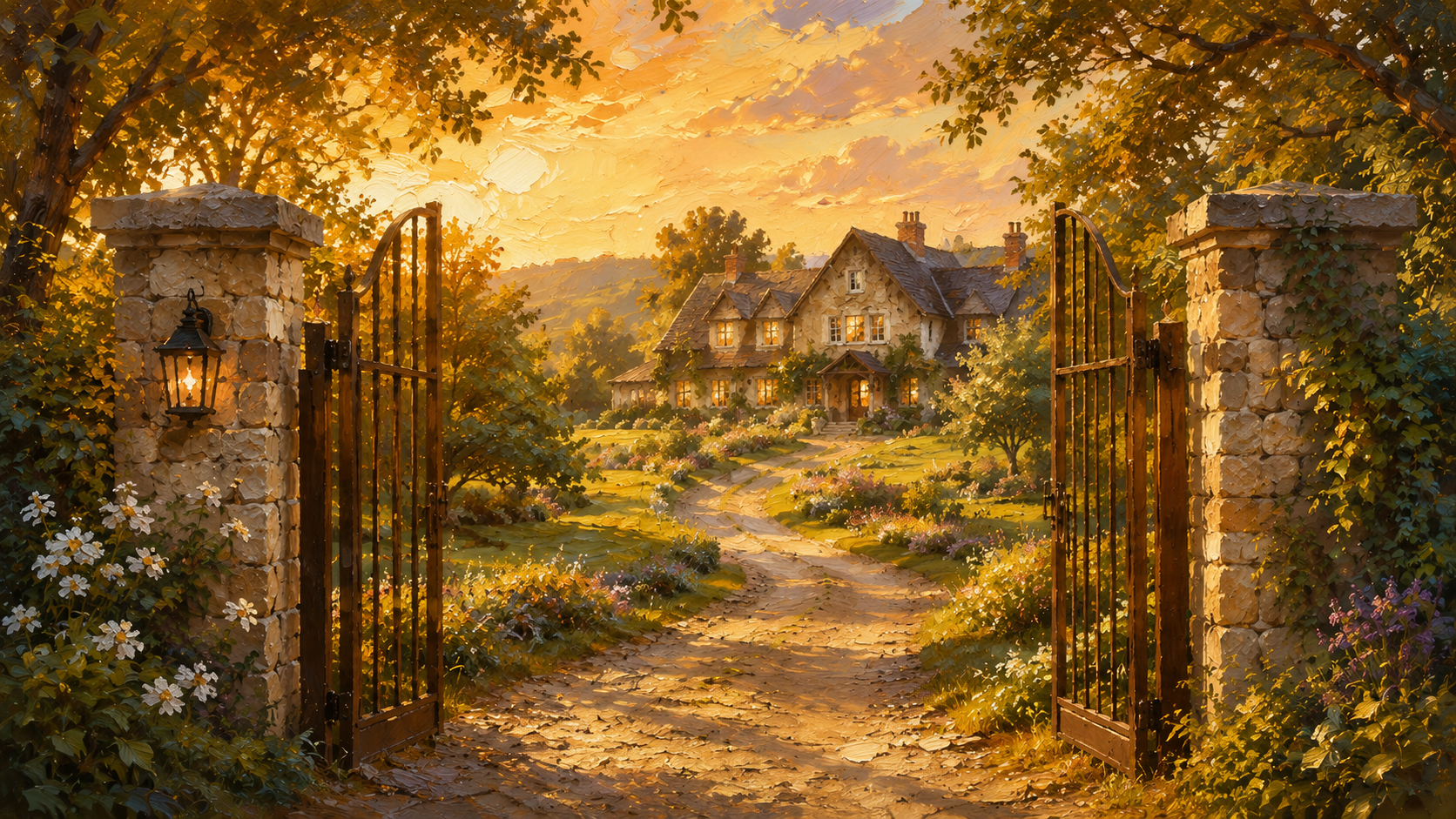
Gates have an odd dual purpose. They mark a boundary. They can keep people out. But they can also open a way in.
I’ve been reading Jonty Allcock’s wonderful book ‘More of Jesus’ in my devotions. Today’s chapter was on gates – and how Jesus calls himself the gate in John 10. Which sent me on a nice little rabbit trail of thinking through a motif in the Bible which I hadn’t given much thought too before.
Gates.
Bear with me for a moment, because it’ll not only make sense but hopefully also give us some scaffolding on how to read the Bible well and see how the Bible unravels motifs in ways that leave us breathless.
1. The Gate we could not pass
The first mention of a gate in the Bible comes in Genesis 3. Sort of.
He drove out the man, and at the east of the garden of Eden he placed the cherubim and a flaming sword that turned every way to guard the way to the tree of life. (Genesis 3:24)
The word ‘gate’ is not used here, but the idea is quite real. Because of humanity’s rebellion against God, they are driven east of Eden. Fearsome angelic beings stand guard at the entrance with a flaming sword, threatening to cut down anyone who dares re-enter.
This first gate in the Bible sets up an ache in every human being – the longing for life with God, but the harsh reality that sinful humanity cannot stroll back in. The way is blocked. Access to God is not casual.
The longing to return is built in each of us – it is, as CS Lewis described, the desire within ourselves that cannot be satisfied with anything earthly. A desire that indicates we are built for something eternal.
But to re-enter this heavenly place of God’s presence is to fall under the sword.
2. Jacob – the Gate of heaven appears
The next time a gate appears which offers access to heaven comes in Genesis 28.
Jacob is not exactly a virtuous character: his story is filled with corruption and deceit. In Genesis 28 he finds himself on the run, vulnerable, and outside the land promised to his forefathers.
But in an extraordinary dream vision he’s graciously given a peak behind the spiritual curtain.
And he dreamed, and behold, there was a ladder set up on the earth, and the top of it reached to heaven. And behold, the angels of God were ascending and descending on it! And behold, the LORD stood above it and said, “I am the LORD, the God of Abraham your father and the God of Isaac. The land on which you lie I will give to you and to your offspring. (Genesis 28:12–13)
This promise to Jacob is thoroughly underserving, and yet God continues to uphold his earlier promises to bless the younger over the older.
When Jacob awakes from this he says:
And he was afraid and said, “How awesome is this place! This is none other than the house of God, and this is the gate of heaven.” (Genesis 28:17)
And there it is again – a gate giving access to heaven. To the presence of God.
A gate that appears not because Jacob has climbed up, but because God has come down and has made promises. It is a gate whose existence depends on God’s divine initiative and promises divine access.
3. The Gate woven into worship
Interestingly from here the idea of the gate to divine presence fades a little from the rest of Genesis – it’s busy turning its attention to Jacob’s (Israel) family and getting them safely away from famine and into Egypt.
But after the exodus, as Israel sits at the foot of Mt Sinai, they receive instructions for a strange tent that will now give them access to God’s presence. Instead of going to search for Eden, a small garden-sanctuary is planted in the middle of the camp – the Tabernacle.
There’s a lampstand shaped like a flowering tree, candle lights to remind them of the star lights from creation, gold, fruit, and a big basin of water. There’s even cherubim, woven into a curtain/veil that separates the inner sanctuary from the Holy of Holies.
A gate.
A reminder that access to the presence of God, like in the Garden, is guarded. Not everyone could waltz in whenever they wanted. Only the high priest could enter – and then only once a year.
And fascinatingly, the tent faced east. So when the priest left, he was heading eastward.
He would leave east of Eden. Each year.
The gate welcomed a human representative in once a year. The way in was real, but restricted.
4. The promised Gates of restoration
For a while, the gate-to-heaven theme seems to fade into the background. The leitmotif seems lost in the chaos of kingship, rebellion, idolatry, and all the fun of the Old Testament.
There’s a moment in Avengers: Endgame where Tony Stark opens the boot of his car and pulls out Captain America’s shield – the shield Cap had dropped at the end of Civil War. But it’s the brilliant musical note that accompanies the moment. When the shield is revealed six musical notes hugged me like warm embrace.
Captain America’s theme.
A theme that hadn’t been heard since his first movie.
Biblical motifs work a little like that. A theme appears, fades into the background, and then suddenly returns with fresh force.
And like a warm embrace, the gate theme reappears in the prophets:
Open the gates, that the righteous nation that keeps faith may enter in. (Isaiah 26:2)
Here the gate is about entry into the secure city of God. Entered only by the faithful.
Your gates shall be open continually; day and night they shall not be shut… (Isaiah 60:11)
Here the line sits in the context of Zion’s restoration and the nations streaming in.
You shall call your walls Salvation, and your gates Praise. (Isaiah 60:18)
This is what the kids back in my day might say is ‘delicious’. The gates of the New Creation are not just architecture, but theological realities: salvation and praise are the entrance into the restored city.
The pantomime prophet, Ezekiel, has some of the most vivid descriptions of the restored creation using Temple imagery. In his prophecy the glory of the LORD departs from the temple. A tragedy in its own right, but it moves east to be with His people in exile. Later, from Ezekiel 43, the glory returns through the gate facing east – then the eastern gate is shut because the LORD has entered it. Ezekiel then ends his prophecy in chapter 48 with the restored city of Zion having twelve gates, three on each side, named after the tribes of Israel. And the city’s name is breathtaking in its weighty simplicity:
The LORD is there. (Ezekiel 48:35)
5. The Gate who is Jesus
If the gate to heaven theme was a musical motif, it would be reaching chaotic crescendos in the prophets – leaving us breathless in wonder, yearning for their completion and triumphal realisation.
But if we trace the Bible’s story line, we’ll see that the music stops. There’s a long silence. A whisper, the breeze gently hushes, but between the final prophet and the next notes in the composition is approximately 400 years.
A long time for the heart to mind and heart to forget the themes that the Old Testament has been introducing and then building and building and building.
A long time without music.
Then, into the silence, six words embrace our hearts like a warm embrace:
ἐγώ εἰμι ἡ θύρα τῶν προβάτων
Well, six words in Greek. Seven in English:
I am the gate of the sheep. (John 10:7)
Jesus goes on: …If anyone enters by me, he will be saved and will go in and out and find pasture. (John 10:9)
This isn’t the gate to heaven in any simple spatial sense. But it is heaven in all that heaven intends – a place of salvation, safety, pasture, and life under the good shepherd. In John’s gospel, this is never less than access to the Father.
Jesus is the way to the Father, the place where heaven opens up. The place that Jacob saw in his dream. The place that the prophets said would come one day.
Jesus is not merely standing beside the gate, pointing us through. He is the gate. The entry point into life with God is not a place, a ritual, familial connections, a temple, or any moral achievements of our own. It is him
6. The Gate opened by blood
But the way back to God was guarded by a sword. A flaming sword in the Garden of Eden – and cherubim woven into the curtain to guard the way to God.
In order for you to return to God’s presence, you needed to go under the sword.
And in a figurative sense, that is what Jesus did. The way to life was guarded by judgement. At the cross, Jesus bears judgement. The shepherd lays down his life for the sheep. The innocent one is cut off so the guilty may come in.
And at his death, something happens that appears strange from one angle, but means so much more when we have Eden, the tabernacle, and the temple in view.
And Jesus cried out again with a loud voice and yielded up his spirit. And behold, the curtain of the temple was torn in two, from top to bottom. And the earth shook, and the rocks were split. (Matthew 27:50–51)
The curtain was torn in two. A sign of judgement on the old temple order, yes, but also a wonder for those with eyes to see and ears to hear:
Therefore, brothers, since we have confidence to enter the holy places by the blood of Jesus, by the new and living way that he opened for us through the curtain, that is, through his flesh… (Hebrews 10:19–20)
At Eden, the way was guarded by a sword. At Calvary, the sword falls on Christ, and the way is opened.
7. The Gates that never close
The death and resurrection of Jesus are the beginnings of an amnesty. A time in which people may come to him in faith and repentance. To own that they have rejected God and loved the world outside the gates. A world of death, destruction, decay. A world in which the fingerprints of God, pointing their way back to him, are routinely ignored.
But by grace through faith, those who come to Jesus find forgiveness, new life in the present, and eternal life with him.
And those who come to Jesus belong to him, and wait for him to usher in a new home. A world in which the themes of old are brought to their richly and eternally satisfying consummation – to a city whose gates are never closed, and access to God is never restricted.
And I saw no temple in the city, for its temple is the Lord God the Almighty and the Lamb. And the city has no need of sun or moon to shine on it, for the glory of God gives it light, and its lamp is the Lamb. By its light will the nations walk, and the kings of the earth will bring their glory into it, and its gates will never be shut by day—and there will be no night there. (Revelation 21:22–25)
These gates aren’t for keeping people out. They welcome people to come in and enjoy him forever.
And beyond those open gates stands the tree of life again. The story that began with humanity barred from the tree ends with the servants of God seeing his face and receiving life forever.
